Tanabata Festival in Aiseki, and the town takes its omens seriously — the team is barely through the gate before they're scolded for whistling indoors, holding a broom wrong, and knocking over a decoration. Running all of it is Lady Tsuyu, the matriarch who governs her family and half the town through an unshakable read on what the stars want. Right now the stars want a wedding: her granddaughter Aika to a young man named Haru, destined and decided.
The team arrives carrying their own unspoken dynamics into the most romantic festival in the country. Kabu has been managing his feelings for Ume badly for weeks. Surrounded by wish-strips and star-crossed lovers in every direction, he manages them worse. Kabocha has been watching this longer than she's let on.
Matsu returns a talisman Tsuyu drops, the team gets adopted into the wedding prep, and the cracks show fast. Kabocha befriends Aika, who's in love with someone else. Kabu befriends Haru, who's in exactly the same bind. The shiso magic — which has been working on this town's unspoken dynamics for months — picks up the team's too. It finds what's unspoken and starts arranging it. Matsu gets caught in the magic's reading of what's destined around Kabocha, and at a ceremonial tea offering he says the thing he wasn't ready to say in a room full of people. She quietly leaves.
In the lull after, Ume finds Kabu and says clearly what she should have said before the magic had a chance to engineer anything: she doesn't feel that way. He asks if it's the turnip head. She loves his turnip head. He has to sit with the actual answer and he does, which costs him something and is also one of his better moments this season.
Ume senses the magic on Tsuyu. The demon manifests at the wedding rehearsal. The fight that follows is where Kabocha finally detonates — at Kabu, at the team, at the whole accumulated weight of the season — and storms out with the sliver in her hand flashing unnoticed. The team defeats the demon without her. Lady Tsuyu, freed, tells them something before the celebration starts: her magic amplifies what's real. It cannot put something there that isn't. Whatever any of them felt tonight was already theirs. The team goes quiet. Matsu is already looking at the path Kabocha took.
OPEN THE BEAT SHEET ▼
- 1Arrival at Tanabata in Aiseki: the team walks straight into a minefield of superstition. Kabu whistles indoors and a shopkeeper gasps; Ume carries a broom bristles-up and gets scolded for sweeping luck away; even meticulous Matsu trips over his own sandals and breaks a decoration. The town's rules are contradictory and constant, and Matsu, annoyed, starts trying to follow every single one, which only makes it worse. Ume finds this very funny. Kabu is distracted. He's been managing his feelings for Ume badly for weeks, and a festival built entirely around star-crossed lovers and romantic destiny is not helping. He keeps manufacturing excuses to be near her. Kabocha has been watching this for longer than she's let on and is visibly done with it.
- 2Matsu returns a talisman Lady Tsuyu dropped — read as a powerful 'lucky act' — and it endears the whole team to her. She invites them into her home and the wedding preparations, and the team gets its first real look at how completely she runs the place.
- 3TURNING POINT — Kabocha befriends Aika, who shyly admits she's in love with someone else and feels trapped. Across the festival, Kabu bonds with Haru, who confesses the exact same secret. Kabu wants to help them; Kabocha accuses him of fixing strangers' problems while ignoring the team's own. Kabu brushes it off — 'we'll talk later.' She looks at him in a way that suggests later never comes.
- 4TURNING POINT — The shiso magic has been working on this town's unspoken dynamics for months and it doesn't stop at the wedding party. It reads the team the same way it reads everyone else: finds what's unspoken and tries to arrange it into destined roles. It picks up Kabu's feelings for Ume and starts engineering moments. The side effect lands on Matsu — the magic reads his dynamic with Kabocha as something to be arranged too, and he starts hovering near her in ways that feel slightly outside his usual quiet orbit.
- 5TURNING POINT — At a ceremonial tea offering, Matsu catches a falling star decoration — another 'highly lucky' act — and Lady Tsuyu jokes that he must be next to marry. The magic has been nudging at him all afternoon and the combination cracks the careful guard he keeps: he stammers that if he were ever to marry, it would be with someone like Kabocha. The room goes quiet. She looks away and quietly leaves.
- 6TURNING POINT — In the lull after the tea ceremony, Ume finds Kabu. She's been watching the whole festival — the wish-strips, the shiso magic bending everyone toward their destined pairings, Kabu manufacturing moments with her — and she's decided to say it clearly. She tells him she doesn't feel that way. He asks if it's the turnip head. She tells him she loves his turnip head. He has to sit with the actual answer: she just doesn't. He doesn't argue. He takes a breath and says okay. It's one of his better moments, and it costs him.
- 7Ume, poking around the estate, clocks that Tsuyu's intensity runs deeper than ordinary superstition and senses magic on her. The team discovers a cursed shiso leaf growing on Lady Tsuyu's back, feeding on her fear of losing control and amplifying her grip on everyone's destined roles — including theirs.
- 8At the wedding rehearsal the shiso demon manifests, tangling Aika and Haru in vines and marching them toward the altar against their will. Tendrils whip out and lash the guests into mimicking the 'proper' rituals.
- 9CRISIS — Mid-fight, Kabocha's frustration finally detonates: Kabu never listens, always assumes it'll work out, never addresses the real problem. Matsu tries to intervene — 'You can't leave now, Kabocha. Don't you see how much you mean to me… to all of us?' Overwhelmed, Kabocha shouts 'I'm done with this!' and storms out. The sliver in her hand flashes, unnoticed.
- 10Down a teammate, the team improvises: Matsu and Kabu free Aika and Haru while Ume brews a potion, throws it on the cursed leaf to sever the connection, and Kabu cuts the demon's core with his scythe. It collapses into harmless shiso leaves. Lady Tsuyu comes back to herself and releases Aika and Haru to marry the people they actually love.
- 11TURNING POINT — Before the town's celebration fully takes over, Lady Tsuyu says something that stops the team: 'My magic binds people to their destined roles. It cannot create feelings that aren't there. Whatever it amplified in any of you tonight — that was already yours.' The team goes quiet. Kabu looks at Ume. Ume looks at Matsu. Matsu is already looking at the path Kabocha took. He doesn't respond. Her absence is the loudest thing there.
SUPPORTING CASTLady Tsuyu · Aika & Haru▼
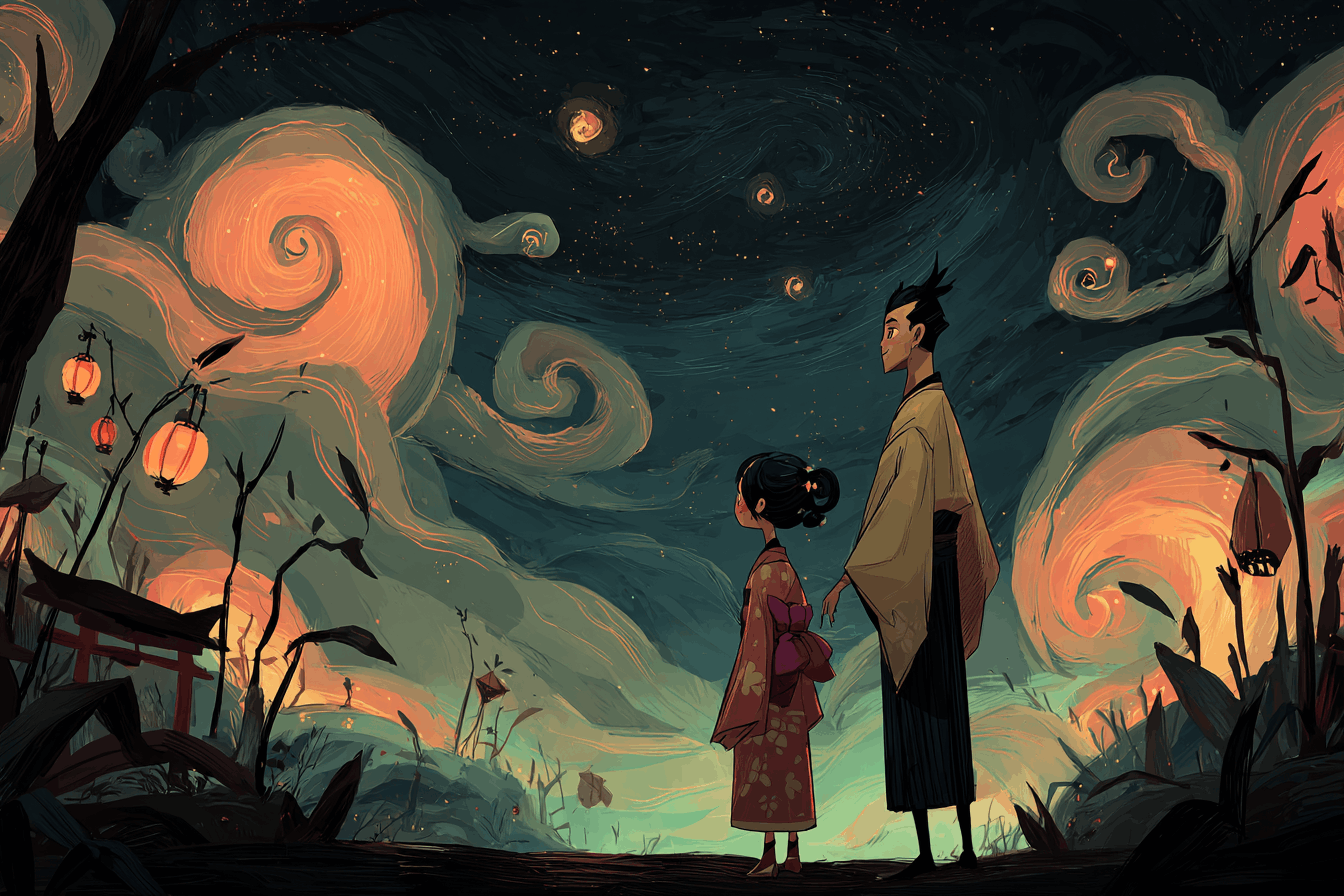
ART DIRECTION — Sendai's Tanabata festival arcade at night: seven-meter paper streamers in rich blues and golds hanging overhead. Musubi-sama floats above the crowd with shiso tendrils radiating outward, tying people together like puppet strings. Kabu looks up at the Milky Way with an expression that is half awe, half panic.
Sendai's Tanabata Matsuri runs three days every August, a month later than most of Japan to stay in step with the old lunar calendar. For those three days the covered shopping arcades downtown fill with seven-meter washi-paper streamers — over three thousand of them, handmade, hung so low you can walk through them. Shop owners spend months building their decorations in secret and unveil them on the first morning to compete for prizes. The first lord of Sendai, Date Masamune, was promoting the festival back in the 1600s.
The festival tells the Tanabata story: Orihime, the weaver princess (the star Vega), and Hikoboshi, the cowherd (Altair), two lovers separated across the Milky Way and allowed to meet just one night a year. Sendai is known for its nanatsu-kazari, the seven traditional decorations, each carrying a wish — paper streamers for Orihime's thread, drawstring purses for wealth, folded cranes for long life, even a paper wastebasket standing for cleanliness. People write their hopes on tanzaku strips and hang them from bamboo.
Here's the part worth sitting with. The romance everyone celebrates is, in the original legend, a punishment. Orihime and Hikoboshi fell so hard for each other that they stopped working — she quit her weaving, he let his cattle wander — and Orihime's father, the sky king, split them apart and rationed their love down to one supervised night a year. The most romantic festival in the country is built on a story about a parent deciding he knew best.