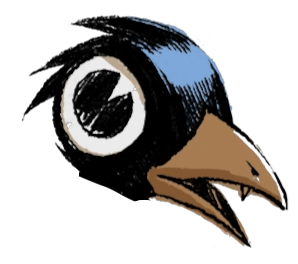
Usokashi looks fine. The orchards are healthy, the stalls are stocked, and everyone in town has an apple pun for a name: Fuji-san, Mutsu-san, Granny Smith-san. There are rumors of an apple demon. There's no visible evidence of one. What's off isn't the fruit.
Kabu, Kabocha, and Matsu were warned to expect ruins and find a cheerful, slightly strained orchard village instead. They meet Akane, sharp, charming, seemingly the only person in Usokashi who wants to help. Kabu has a crush immediately. Kabocha makes a crack about Ume. Akane files both reactions away.
The Apple Whisper Seed's curse moves through contact: Akane leans close to someone, and a small worm curls into their ear. She's been working through the village for weeks. Kabu is open enough that she gets one in without any trouble. Kabocha and Matsu are harder targets, though being harder to worm doesn't mean they're immune to what she tells them.
She's been working the team separately, different stories, different angles, each one tailored to the specific thing each person is quietly afraid of. The seed pouch goes missing. Nobody can agree on anything. The town is fine. The team is not.
Kabocha lifts the pouch off Kabu herself and says she doesn't know where it is when he asks. Akane finds him minutes later with an answer ready: Kabocha took it, and she's the only one in this town telling him the truth. By the time Kabocha comes looking for him to explain, he's already decided who the liar is.
Akane sings 'Apple a Day' to herself, alone, while the team scatters across the orchard chasing leads she's handed them one at a time. The audience can see the shape of what she's doing. Nobody in Usokashi can yet. When Kabocha finally catches up to Kabu, he doesn't listen. He tells her she's the liar, that Akane told him everything, that Akane is the only real friend he has in this town. His own confusion becomes 'One Bad Apple,' sung with nobody left to organize around and no idea who to trust.
Akane reveals what she is in the fight that follows: red kimono, rot showing through pale skin, a voice that already knows where to aim. She tells Kabocha how it feels to be a failure on the run. The thorn in Kabocha's hand pulses and doesn't stop. She tells Matsu he'll never be the warrior his father was, and he goes still. She tells Kabu he'll never be a hero.
Kabu doesn't take the bait. He tells her he doesn't care, that she's just jealous of Kabocha, the strongest person he knows, and that she doesn't need to corrupt people to have friends, he'll be hers for free. The worm in his ear goes quiet mid-sentence. While he holds her attention, Kabocha and Matsu move through the village clearing worm after worm out of the people Akane's been controlling. Every villager they free costs her more. By the time the last worm is gone, she can barely stand, and Kabu takes the seed without a fight. She collapses, ashamed of what she did to hold onto three people for a few days.
That night the town holds its Lantern Festival, restored and grateful, and presses a paper lantern into the team's hands. Kabu announces to nobody in particular that he is never falling for a pretty girl again. Ume walks around the corner as he says it. He shrieks.
OPEN THE BEAT SHEET ▼
- 1Arrival in Usokashi: the town looks fine. The orchards are heavy with fruit. Everyone has an apple pun name: Fuji-san, Mutsu-san, Granny Smith-san, and uses them with a cheerfulness that doesn't quite reach their eyes. The team was warned to expect ruins. What they find is harder to name: a town that looks healthy but holds itself like a place that has stopped trusting its own neighbors.
- 2They meet Akane, an orchard girl with quick wit and easy warmth. Kabu is immediately smitten. Kabocha teases him about Ume. Akane listens to all of it and files every detail away. She seems like exactly the kind of person who might join the team. Meanwhile, Kabocha has been out in the fields practicing her pumpkin leaf throws, getting more precise, and she knows it.
- 3TURNING POINT — The Apple Whisper Seed's curse moves through contact: when Akane leans close to someone and speaks, a small worm curls into their ear. She's been working through the village for weeks. Kabu is too open to her to notice when she gets one in. She fails with Kabocha and Matsu. They're harder to reach. Neither of them knows Kabu is compromised.
- 4TURNING POINT — Separate manipulation, Kabu: Akane takes him aside and plants one quiet suggestion. Kabocha and Matsu are drifting together, and Kabu isn't part of it. She says it gently, like she's worried for him. The worm finds the insecurity already there and settles in.
- 5Separate manipulation, Kabocha: Akane finds a moment alone with Kabocha and says something small and pointed: that Kabu might be planning to keep the seeds for himself when this is over. She invokes Ume by implication, that Kabu already has somewhere to go, and Kabocha is useful for now. Kabocha can't be wormed. She falls for it through her own suspicion instead.
- 6TURNING POINT — Kabocha lifts the seed pouch off Kabu and hides it. When Kabu asks where it is, she says she doesn't know. Akane finds Kabu shortly after and tells him what she frames as the truth: Kabocha took it. 'She's lying to you. I wouldn't.' The team is now fractured in silence. No shouting, just three people who have stopped looking each other in the eye.
- 7CRISIS — 'Apple a Day' (Song 9): Akane's villain reveal song, performed while the team runs in separate directions across the orchard, each one chasing the lead she's handed them. The audience sees what's happening. The characters don't. The song ends with Kabocha arriving to confront Kabu directly, and Kabu turning on her: 'You're a liar. I know you took the seeds. Akane told me. She's the only one in this town being straight with me.'
- 8TURNING POINT — 'One Bad Apple' (Song 10): Kabu's breakdown anthem. Trust has fully collapsed. He can't organize, can't make decisions, can't coordinate with anyone. Akane watches from the orchard's edge, satisfied. The village's poisoned relationships surround the team like a mirror held up to their own.
- 9TURNING POINT — Battle: Akane transforms, red kimono, rot visible under pale skin, and attacks with each person's confided fear. To Kabocha: 'How does it feel to be a failure on the run?' The thorn in Kabocha's hand pulses hard. She tries to shake it off; it doesn't go. To Matsu: 'You'll never be the warrior your father was.' He goes still. To Kabu: 'You'll never be a hero.'
- 10TURNING POINT — Kabu's breakthrough: 'I don't even care! You're just jealous of Kabocha. Kabocha's the strongest person I know!' He steps between Akane and Kabocha. No weapon. Just himself, looking at her directly: 'You don't need to corrupt people to be friends. I'll be your friend.' The worm in his ear goes quiet. Her hold on him breaks. The moment the control fails, her power starts to drain.
- 11While Kabu holds Akane's attention, Kabocha and Matsu move through the village destroying whisper-worms. Every villager freed is one less source of her strength. When the last worm is gone, Akane is barely standing. Kabu takes the cursed seed without a fight. She collapses: ashamed, defeated, not beyond redemption.
- 12That night, Usokashi holds its Lantern Festival. The town is restored. The villagers press a paper lantern into the team's hands, warm and unsteady light. Kabu announces, loudly and with feeling: 'I am never falling for a pretty girl again.' Ume walks around the corner. He shrieks.
SUPPORTING CASTAkane▼
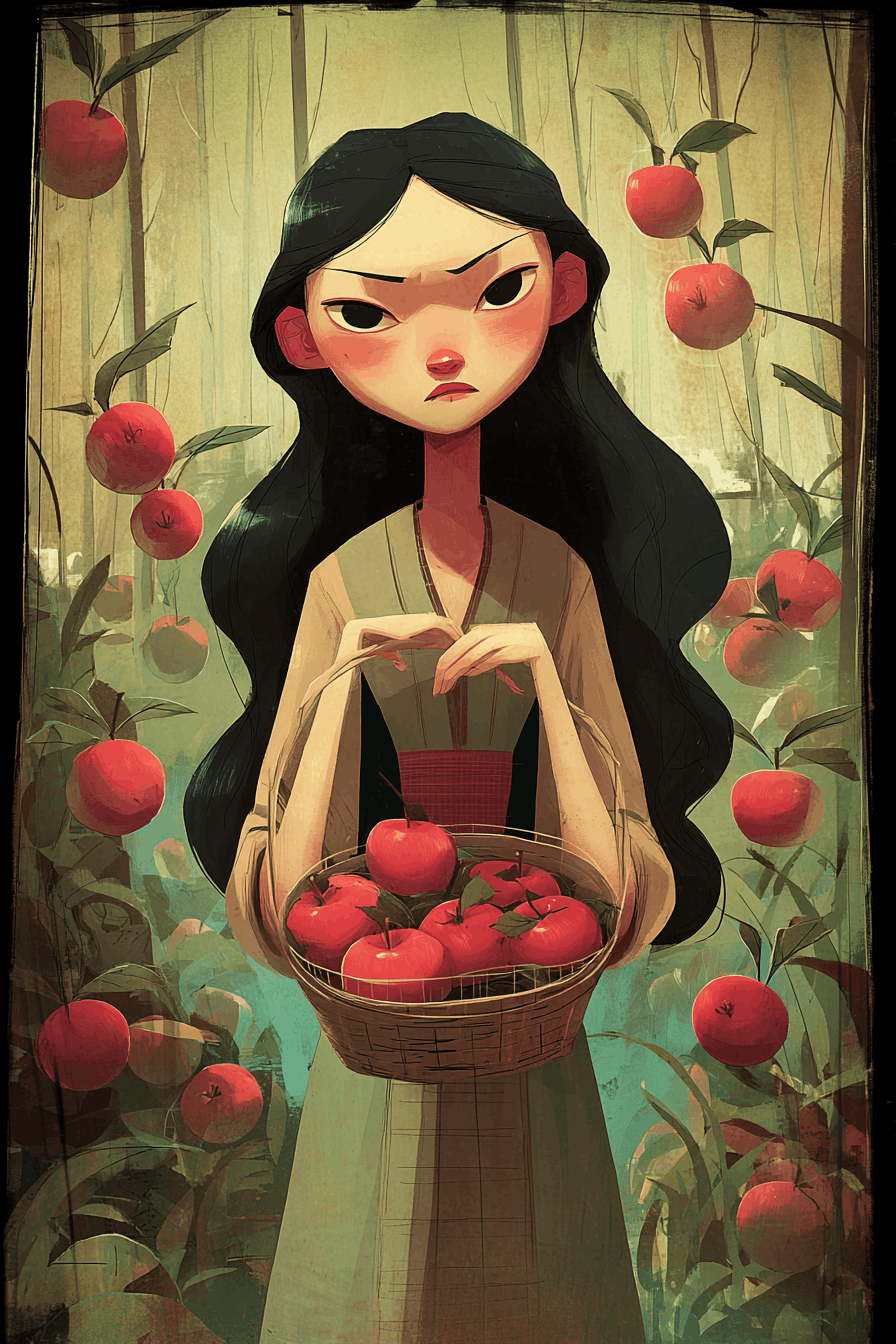
ART DIRECTION — Usokashi's Lantern Festival at dusk: paper lanterns in warm orange and red, the apple orchard surrounding the town square. Akane stands center, smiling, arms open. Behind her, her shadow is wrong: stretched and sharp. Kabu, Kabocha, and Matsu are arranged in a triangle around her, all slightly turned away from each other.
Aomori Prefecture is at the northern tip of Honshu, where winters bury the land in snow and rice farming had always struggled in the cold. The Tsugaru region looked, on paper, like a bad bet for any serious crop. Then the Meiji Restoration abolished the samurai class in the 1860s, and thousands of former warriors in the Hirosaki domain found themselves with land, time, and no purpose. The government distributed apple saplings imported from the United States and told them to farm. It worked, not because the climate was easy (it wasn't), but because Aomori's ex-samurai brought the same stubbornness they had carried as fighters. The local word for that quality is joppari. Today the prefecture produces about 60% of Japan's apple supply.
The orchard became the culture. Hirosaki's manhole covers are decorated with apples. Onsens float ripe fruit in the steaming water during harvest season. The ash from burned apple branches glazes the local pottery with its distinctive darkened finish. Dozens of varieties have been cultivated here: Fuji, Mutsu, Orin, and more, each with its own season and devoted growers. The Fuji apple, Japan's most popular, isn't named after the mountain. It was developed in 1939 in a small town called Fujisaki, and when the naming committee finally picked a name in 1962, that was the one they settled on. Most people assume the obvious thing.
Every summer, the Nebuta Festival fills Aomori's streets with enormous illuminated warrior figures built from paper and wire, carried through the city on wagons while crowds carry hand-held lanterns alongside them. The floats take months to build. From a distance they look effortless, vivid and almost weightless. In Aomori, the most beautiful things tend to be built that way: careful, slow work underneath, nothing showing on the surface.