The team returns to Furumi, eerily quiet and crow-haunted. They uncover the Crow Witch's backstory through magical remnants — she was once a powerful Tengu who challenged Madarao's authority, was defeated, and forced into subordinate servitude. The cursed seeds were her method of collecting soul energy for Madarao as tribute. Kabocha, manipulated by the Crow Witch, ambushes the team — using her knowledge of their weaknesses against them. Kabu refuses to fight her directly. His friends' appeals reach her; Kabocha shatters the seed fragment in her own hand. The Crow Witch, furious at her pawn's defection, attacks and is driven to retreat. Finale sets up: they must climb Mount Madarao.
OPEN THE BEAT SHEET ▼
- 1The team returns to Furumi — eerily quiet, crow-haunted, wrong in ways they can't name.
- 2Magical remnants reveal the Crow Witch's backstory: a Tengu who defied Madarao and was broken for it.
- 3TURNING POINT — Kabocha, manipulated, ambushes the team using her intimate knowledge of every weakness.
- 4TURNING POINT — Kabu refuses to fight her directly. His restraint is not passivity — it is the hardest choice he's made.
- 5CRISIS — The others' appeals reach Kabocha. She shatters the seed splinter in her own hand.
- 6TURNING POINT — The Crow Witch, furious at losing her pawn, retreats. One final climb remains: Mount Madarao.
SUPPORTING CASTCrow Witch (full arc revealed)▼
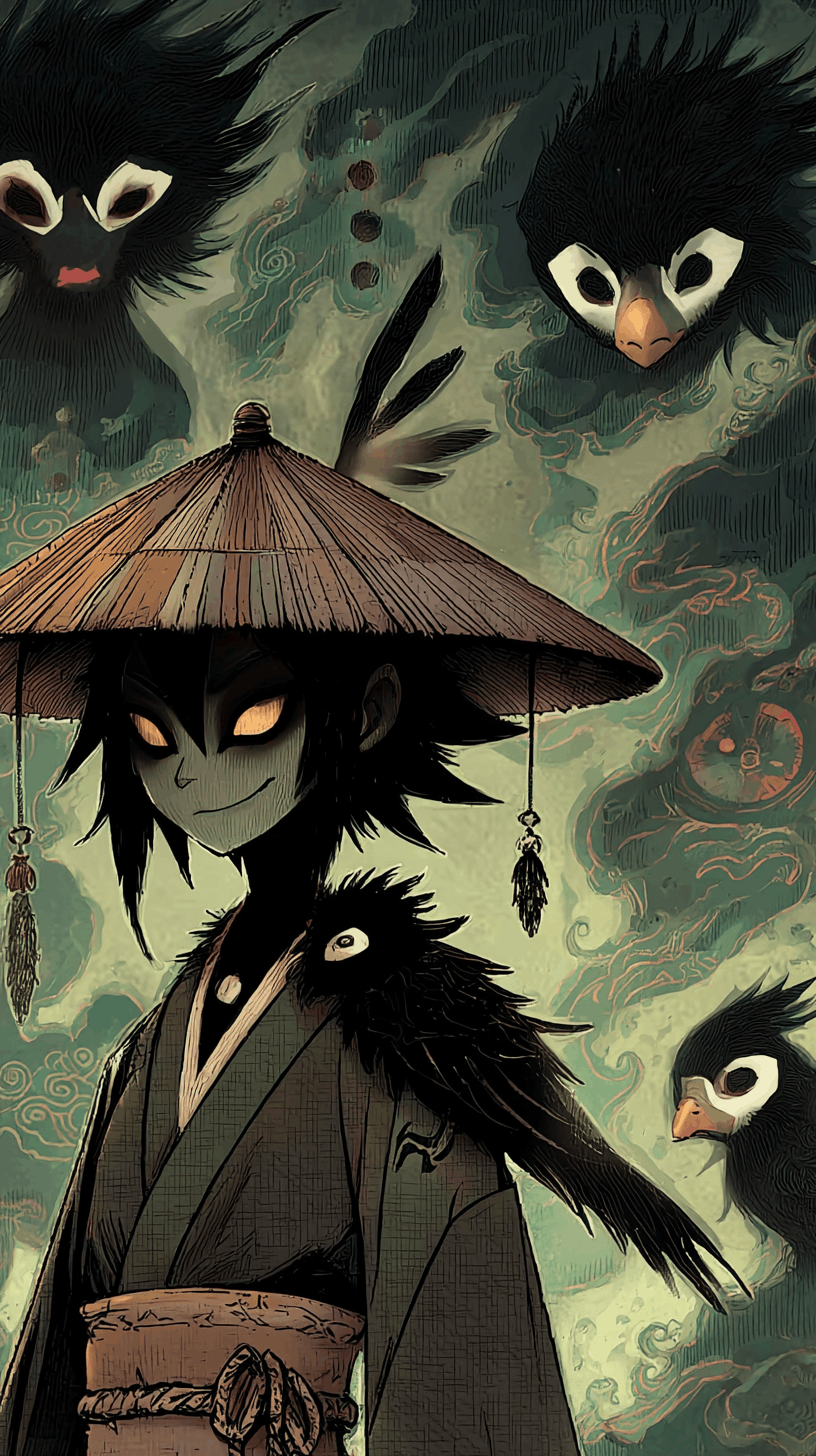
ART DIRECTION — Furumi at night: the village square empty, crows roosting on every surface. In the center, Kabocha faces the team — her silhouette wrong, edges sharp where they should be soft. The Crow Witch is visible in the background, watching from the treeline. The scene has the staging of a Western standoff: three heroes, one friend who is currently an enemy, one enemy who is briefly on the right side.
Returning to Furumi means returning to the Nagano mountain foothills — but a version that has been waiting in stillness. The village that began the story as dying-but-alive is now genuinely haunted: its original blight replaced by a deeper silence, crows where there were people. In Japanese folklore, Tengu are mountain spirits most strongly associated with alpine terrain — the Japan Alps, the dense forests of Shinshu, the remote high passes of Nagano Prefecture. A lesser Tengu forced into servitude to a more powerful one reflects the rigid hierarchical structures of the Edo period that influenced these myths: a powerful being, defeated, pressed into bureaucratic tribute. The crow witch's origins map directly onto this geography — a spirit of the high mountain, working through proxies in the lowland towns because she cannot return to where she belongs.